On June 9, 2026, a new law quietly went live in New York.
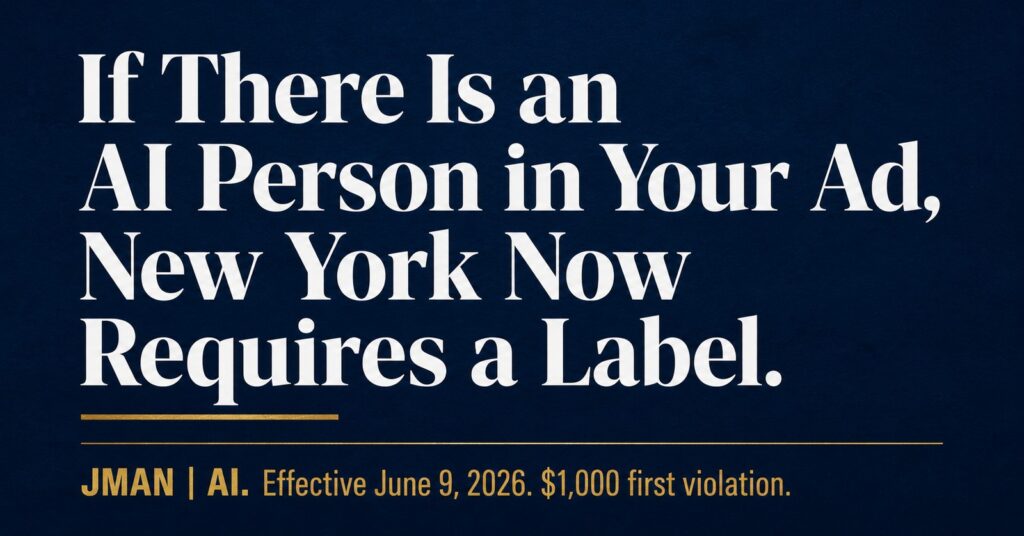
If you put an AI-generated person in a marketing video and that ad reaches a New York audience, you are now required to conspicuously disclose it. First violation is a thousand dollars. Every one after that is five thousand.
The law has been enforceable for about two months. I have not seen a single agent post about it.
So let me walk you through what it actually says, what it does not say, and the one question that matters most if you have been building AI avatars for your marketing.
What the law actually is
The formal name is New York Senate Bill S.8420-A, signed by Governor Hochul on December 11, 2025, and enacted as Chapter 617. It amends Section 396-b of the New York General Business Law. The press has been calling it the Synthetic Performer Disclosure Law.
It is the first law of its kind in the country.
The core requirement lives in one sentence. If you are in the business of dealing in any property or service, and you produce an advertisement for commercial purposes, and that advertisement contains a synthetic performer, and you actually know it does, you must conspicuously disclose it in the ad.
Read that list again, because every piece of it matters. Property or service. That covers real estate on both counts. Commercial purpose. That covers your listing videos, your brand reels, your recruiting content, your open house promos. Actual knowledge. If you made it, you know.
What counts as a “synthetic performer”
This is where most people are going to get it wrong, so slow down here.
The law defines a synthetic performer as a digitally created asset, made or modified by computer using generative AI or a software algorithm, that is intended to create the impression that the asset is engaging in a visual or audiovisual performance of a human performer who is not recognizable as any identifiable natural performer.
Plain English: it is a fake person who looks like a real person but is not any actual real person.
So what is covered:
An AI-generated spokesperson delivering your market update. Covered.
An AI “happy homeowner” you generated to appear in a testimonial-style ad. Covered, and frankly that one is a bigger problem than the disclosure requirement.
A generic AI presenter you built to front your brand videos so you did not have to be on camera. Covered.
An AI-generated family walking through a home in your listing promo. Covered.
What is not a synthetic performer under this specific law:
Virtual staging furniture. That is not a performer. Different set of rules entirely, which I wrote about separately when California passed AB 723 on altered listing photos. Furniture in an empty room is a property representation issue, not a performer issue.
An enhanced photo of a real house. Same thing. Different law, different problem.
The digital avatar question nobody is asking yet
Here is the part I find most interesting, and I say this as someone who teaches digital human avatars.
The definition hinges on one phrase: not recognizable as any identifiable natural performer.
If you build a digital avatar of yourself, trained on your face, your voice, your mannerisms, and viewers recognize it as you, there is a real argument that it falls outside this definition. It is not an unidentifiable synthetic person. It is a digital version of an identifiable one. You.
If you generate a completely fabricated presenter who exists nowhere in real life, that is squarely inside the definition.
Those are two very different things, and the law treats them differently on its face.
I want to be careful here. I am not your attorney, and this specific question has not been tested. If you are running avatar-fronted campaigns at scale in New York, that is a conversation for real counsel, not a blog post. But the distinction is written into the text, and if you are choosing between building an avatar of yourself versus generating a stock AI presenter, the legal ground is not identical.
Worth knowing before you build.
What is exempt
The law carves out more than people expect.
Audio-only advertisements are exempt. If you use an AI voice on a radio spot or a podcast ad and there is no visual performer, this law does not reach it. That is written directly into subdivision seven.
Language translation is exempt. If you film yourself, then use AI solely to translate your performance into Spanish or Mandarin, that is not a synthetic performer. You performed. The AI translated. No disclosure required under this section.
Expressive works are exempt. Movies, TV, streaming content, documentaries, video games. If a synthetic performer appears in the promo material for one of those and its use matches how it appears in the actual work, no disclosure needed. This carve-out is for Hollywood, not for your listing video.
The platforms are exempt. Newspapers, magazines, TV stations, streaming services, cable systems, billboards, transit ads. The medium that runs your ad is not liable for your disclosure failure. You are. The obligation sits with the advertiser, which means it sits with you.
What this means for your marketing this week
Three moves, and none of them take long.
One. Audit what you have already published. Go through your last ninety days of video content. Any ad with an AI-generated human in it that ran to a New York audience after June 9 is potentially exposed. If you find one, add a disclosure or take it down.
Two. Build the disclosure into your template now. Not as an afterthought. A simple on-screen line works: “This advertisement features an AI-generated performer.” Conspicuous means visible and readable, not buried in a caption at the bottom of a description box. Put it where a normal person would actually see it.
Three. Know which lane your avatar is in. If you are avatar-forward in your marketing, decide deliberately whether you are building a digital version of yourself or generating a synthetic person, because those are different legal positions and different brand positions.
And one bonus move. If you run paid social, remember that your targeting probably reaches New York whether you intended it or not. A Rochester agent is obviously in scope. So is a Florida agent running a national campaign that lands in a New York feed.
The bigger pattern
This is the second time in 2026 that the law has moved on AI in marketing while most of the industry was looking somewhere else.
California went first with AB 723 on digitally altered listing photos, effective January 1. New York followed with synthetic performers, effective June 9. Different states, different targets, same underlying idea.
If you change what the audience sees, you tell them.
That is the whole principle. It does not care whether a human or a machine did the editing. It does not care how good the tool is. It cares whether the person watching knows what they are looking at.
I have said for a while that AI is not coming for the relationship, it is coming for the busywork. That is still true. But the flip side is also true. The moment AI starts producing something that looks like a person, the rules that govern people start showing up. That is not a bug. That is the system working the way it should.
The agents who get hurt here will not be the ones using AI. They will be the ones using AI without reading anything.
The honest disclaimer
I am a trainer and a speaker, not an attorney. This is a plain-English read of a public law, not legal advice for your situation. New York’s law is new, untested in court, and the avatar question in particular is genuinely unsettled.
If you are running significant AI-generated campaigns, talk to your broker and to real counsel. Get it in writing. That is what they are for.
What I can tell you is that the law exists, it is live, and the penalty schedule is public. Knowing that is now part of the job.
Want help building AI into your business the right way?
Reading about AI and actually operating with it are two different sports. Compliance is part of operating.
Done for you: I build custom AI chatbots for agents at Big Brain Chatbots.
Learn it yourself: come into AI-Cademy, where we work through this live every week, including the guardrails.
Ready to go all in? The six-week AI-Cademy Bootcamp.
Not ready yet? Start with my free guides.
One question before you go. Have you run an ad with an AI-generated person in it this year? If you are not sure, that is your answer on where to start.
JMan is a national real estate trainer, speaker, and AI educator who makes the complicated stuff simple and usable. Learn more at jmanai.com.
Sources
- Full bill text: 2025 New York Senate Bill No. 8420, Chapter 617, Laws of New York 2025
- Fake performer, real penalty: What advertisers need to know before June 9 (Reed Smith)
- New York Enacts Synthetic Performer Disclosure Law (Cooley)
- Synthetic Performers, Real Consequences (Crowell & Moring)
- Two Newly Enacted New York Laws Will Regulate Certain AI-Generated Images (Skadden)