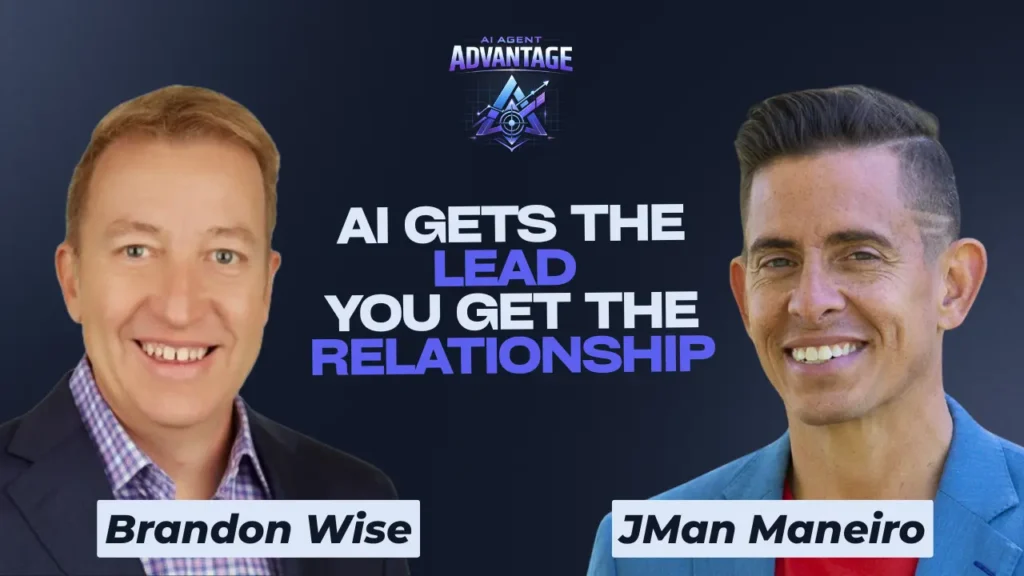
Most real estate agents think AI means ChatGPT, a new listing description generator, or some app that promises to triple their leads. Brandon Wise has a different perspective. The co-founder and CEO of Wise Agent CRM has been watching agents chase technology for over 20 years, and he’s seen the pattern clearly: the agents who win are not the ones running after every new tool. They’re the ones who build consistent, relationship-first systems and let technology run in the background.
On this episode of AI Agent Advantage, JMan sat down with Brandon to talk about what a CRM actually does, what AI tools are already built inside Wise Agent, and why the agents getting the most out of technology are the ones logging in every single morning.
What a CRM Actually Is (and Why It’s More Than a Contact List)
CRM stands for contact relationship management, but that definition undersells it. A good real estate CRM is the operating system for your entire business. It holds every contact you’ve ever met, categorizes your leads, tracks your transactions, walks you through follow-up sequences, and tells you what to work on each morning.
Brandon puts it plainly: the agents who scale are the ones who stop trying to run their business from memory. A CRM is what makes your client relationships repeatable and your income more predictable.
The challenge is that most agents use their CRM the way most people use the gym membership they bought in January: they get set up, do well for a few weeks, and then drift away. Brandon sees this pattern constantly. The agents who get results are the ones who treat their CRM login as a non-negotiable part of every morning.
The AI Writing Assistant: Campaigns Built for Real People
One of the most used AI features inside Wise Agent is the writing assistant. When a lead comes in, the temptation is to add them to a generic buyer campaign and hope something lands. Brandon argues that this is exactly why most drip campaigns feel like spam.
The AI writing assistant lets agents build highly specific campaigns for specific situations. A first-time buyer looking at condos in Scottsdale needs a completely different conversation than a move-up seller or a second-home investor. The writing assistant makes it fast to build those specific campaigns rather than defaulting to something generic.
"In the past, you'd call us and say 'can you write a campaign for this scenario?'
and it would take us two weeks to get something quality out. Now you can do that in minutes for every scenario you have."
— Brandon Wise
The key insight here is that personalization is no longer a luxury only top producers can afford. Any agent willing to put in ten minutes of setup can now have campaigns that feel tailored to whoever they’re talking to.
The AI Follow-Up Bot: A Year of Persistence Without the Burnout
The feature Brandon spent the most time on is the AI texting bot, and it’s worth understanding exactly how it works.
When a new lead comes in, the bot introduces itself by name, acts as the agent’s assistant, and starts a text conversation. It asks qualifying questions based on what the lead is looking for. Are they pre-approved? What neighborhoods interest them? Are they open to a condo, or do they need a yard? The bot listens to responses and formulates follow-up questions that feel like a real conversation.
Here’s the part that most agents miss: the bot keeps going. Where a human agent might text a lead three or four times before giving up, the bot will keep trying, without frustration, for a full year. Brandon shared a story about an agent who loaded 100 stale leads, some sitting for two years without contact, into the system. A handful converted. The timing had simply been wrong the first time.
"The AI bot doesn't have feelings. It just keeps trying. And we've had leads come back six months later because it happened to send a text at exactly the right time."
— Brandon Wise
When a lead is ready to move forward, the bot doesn’t keep going. It sends the agent a notification and hands off the conversation cleanly, introducing the agent by name so the transition feels natural. The lead often doesn’t even realize they were talking to an AI.
Your Database Is Your Business: Build It Like You Plan to Sell It
One of the sharpest points in this conversation is the idea that your database has real financial value at the end of your career. Most agents fade out of the industry rather than exit with anything to show for it. Brandon says it doesn’t have to be that way.
A clean, well-maintained database with detailed notes, contact categories, sourcing information, and relationship history is something a newer agent will buy when you’re ready to step away. But it only works if you’ve actually kept it up.
This means recording where every contact came from, what their interests are, when you last spoke and what you talked about, and any personal details that let you make conversations feel human. A contact who is a runner should be in a runners category so you can send them a note about the local marathon. A client who mentioned their dog’s name during a listing appointment should have that dog’s name in the system, because knowing it at your next meeting is the kind of thing that wins you the listing.
The Consistency Pattern
Brandon has watched agents use Wise Agent for over two decades, and the pattern among those who get results is not sophisticated strategy or a particular feature. It’s consistency.
The agents who succeed open their CRM dashboard every morning before doing anything else. They see who needs a call, what transactions are in motion, and what their day actually requires. Instead of reacting to whatever comes first, they work from a clear list of income-producing activities.
Wise Agent sends a daily email summary each morning with exactly what needs attention. Brandon describes it as a CEO briefing: here is what matters today. For agents prone to distraction, or anyone running a busy business across multiple client types, that structure is what keeps the machine moving.
The Rule Brandon Leaves Every Agent With
At the end of the episode, JMan asked Brandon for the single best tip for someone getting started with AI. His answer had nothing to do with features or tools.
"Don't just use what AI gives you out of the box.
Tell it what you would do, then let it edit your writing.
Make sure it sounds like you. People hired you for you."
— Brandon Wise
It’s the same principle that runs through everything he said: technology is only as good as the human behind it. The CRM doesn’t build relationships. The AI bot doesn’t close deals. But give those systems a person who shows up consistently, who puts real information in, who takes the handoff when the lead is ready, and the whole thing works.
Guest Bio
Brandon Wise is the co-founder and CEO of Wise Agent CRM, a real estate contact relationship management platform he built after working as an agent in Scottsdale, Arizona. Overwhelmed by the complexity of the business and worried about staying organized enough to avoid legal liability, Brandon sketched the idea for Wise Agent on a napkin alongside his future CTO. More than 20 years later, Wise Agent has outlasted dozens of competitors by focusing on customer relationships over feature bloat, and by being, as Brandon puts it, the only technology company in real estate that actually answers its phone. Brandon is a frequent speaker and advocate for using AI to create more human time in the business, not less.
LinkedIn: https://www.linkedin.com/in/brandonwiseaz/
Website: wiseagent.com
https://www.jsquaredpodcast.com/
Ready to put this AI to work?
This is what we break down every week. Grab the free AI guides, or come build it live with us inside AI-Cademy.
Get the Free AI Guides Explore AI-Cademy