Most people who leave corporate do it on their own terms. They save six months of runway, they plan the exit, they have something lined up.
JMan and Jeffrey Scott Stanton did not get that version.
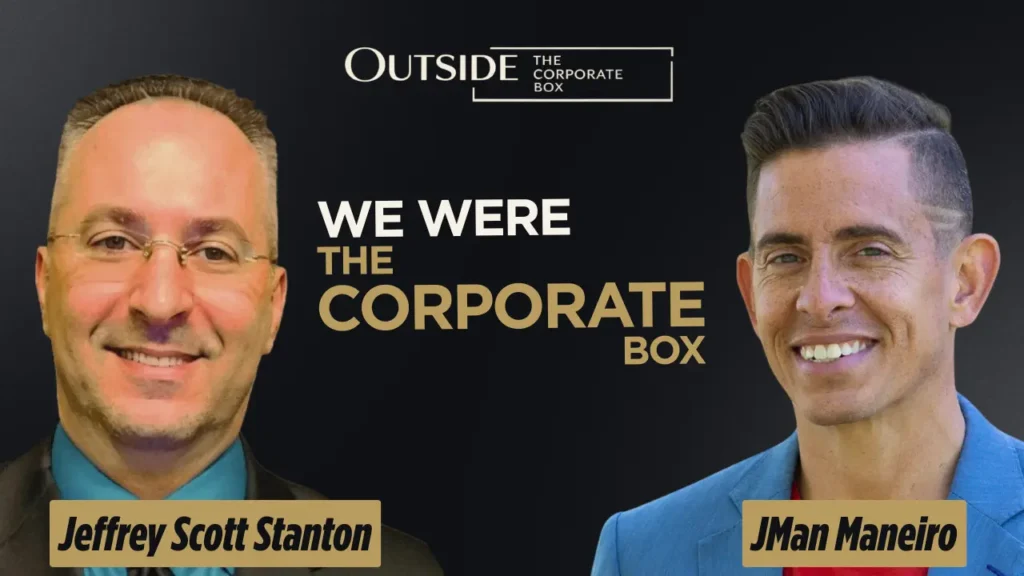
In the latest episode of Outside the Corporate Box, the two hosts turn the mic on themselves for the first time, sharing what happened when the careers they had built their identities around came to an abrupt end, and what they had to figure out on the other side.
It is one of the most honest conversations the show has produced. And it starts with a question most people never think to ask until it is too late: what happens when the thing you love doing is also the only thing you are?
The Corporate Identity Trap
Jeffrey spent ten years as Executive Vice President of Learning and Development at Douglas Elliman Real Estate, overseeing training, coaching, and professional development for somewhere between 6,000 and 7,000 agents across one of the most recognizable luxury brands in real estate. He was branded constantly. Everywhere he went, he carried the organization’s name alongside his own.
He loved it. He was not coasting. He was not sleepwalking through a paycheck. He woke up every morning genuinely glad to be doing what he was doing.
That is precisely what made it dangerous.
"I think what happens is when your work becomes your identity, when that stops,
either by choice or if it is taken away from you, that hurts."
— Jeffrey Scott Stanton
JMan came into that same ecosystem from the outside, pulled in as a national trainer during the pandemic years. His background was entirely different, having been an entrepreneur since age 19, so the corporate structure never felt natural to him. But the mission pulled him in. The company’s reach and the people they were serving made it feel worth staying.
Both of them poured everything into it. Which meant that when it ended, everything ended with it.
The Part Nobody Talks About
When you lose a job you love, people tend to say reassuring things. They tell you that you will be fine, that you are talented, that something better is on the way. What they do not tell you about is the phone.
Jeffrey describes it clearly in the episode: when you are running a nationwide operation, you are fielding calls from eight in the morning until eight at night. People on the East Coast, people on the West Coast, back to back. The constant contact is not just professional, it feels like proof that you matter, that your presence has weight in the world.
Then the calls stop. The emails thin out. The texts stop coming. And the silence hits differently than you expect.
"I said, yeah, it is getting kind of lonely, because you are so used to that interaction with people."
— Jeffrey Scott Stanton
There is also the harder discovery: some of the relationships you thought were personal turn out to be professional. People who picked up every time you called stop picking up when you no longer have the title. It is not personal in the way that stings, it just turns out you were building industry relationships, not friendships, and nobody warned you those were two different things.
Grief Has a Process, Even in Business
Both men describe the experience of losing a role you loved in terms of grief, because that is actually what it is. There is the initial gut punch, the disbelief, the confusion. Then comes the anger. Then the bargaining. Then, eventually, acceptance.
What makes this conversation worth listening to is the honesty about how long that process takes and how it differs depending on how much of yourself you put in. For someone who spent a decade building their identity around a title, the grief runs deeper and lasts longer. That is not a character flaw. It is the cost of genuine commitment.
The analogy both hosts reach for is the end of a relationship with someone you genuinely loved. Not a bad relationship. Not someone who mistreated you. Someone you were fully invested in, and then could not be with anymore. The grief is real regardless of whose choice it was.
No Other Options as a Strategy
The episode shifts when the conversation turns to what came next. Both JMan and Jeffrey talk about how the reinvention started, not with a plan, but with a wall at their backs.
JMan references a guest from an earlier episode who talked about burning the boats, the idea that when there is no retreat available, you find a way forward that you never would have found otherwise. For someone who spent years as a trainer and speaker while their real estate team ran mostly without them, the wake-up was sharp: there was no fallback. There was no safety net. There was only forward.
"I think we are at our best when we have no other options.
Bills do not stop. There is no plan B for me."
— JMan
There is a counterintuitive point buried in this section that is worth pulling out: having a safety net can actually prevent full commitment. Both hosts reference the common pattern of someone keeping one foot in a corporate role while building a side hustle, spreading energy across two lanes, and never fully accelerating in either one. The disruption they experienced forced a clarity that a well-planned transition might not have produced.
What Discipline Actually Means Outside the Box
One of the most practically useful moments in the episode comes when the conversation turns to what actually makes entrepreneurship work. The answer is not talent. It is not passion. It is not even hard work in the way most people mean it.
It is discipline.
Jeffrey puts it plainly: discipline beats hard work. Discipline beats smart. When you are consistent enough over a long enough period, you can outwork almost anyone, regardless of natural ability. The person who picks up the phone every morning, who records the podcast, who shows up to the role-play call, who does the unremarkable tasks without waiting to feel motivated, that person compounds over time.
What makes this worth saying is that outside the corporate structure, there is no one requiring that consistency. No manager. No performance review. No meeting on the calendar that forces accountability. The discipline has to come from somewhere internal. And building that internal discipline is the actual work of becoming an entrepreneur, not the business idea or the branding or the strategy.
What They Would Tell Themselves
Near the end of the episode, JMan asks Jeffrey the Last Question: if you could go back five years and tell yourself one thing, what would it be?
Jeffrey’s answer is immediate: do not get too comfortable.
He expands on it with an image that is worth keeping. He talks about filling cups. The idea that there are multiple parts of your identity, multiple versions of who you are and what you care about, and when you pour all of your energy into one cup for too long, the others run dry. The job fills up. The speaking business empties. The real estate team runs on fumes. The relationships get maintenance-level attention. And then the one full cup gets knocked over, and you have to start from scratch across the board.
JMan’s answer is different but arrives at the same place. Do what you love, no matter what. Serve people something of value. That combination, genuine work and genuine usefulness, travels with you regardless of which company’s name is on your badge.
"If you serve people something of value, you can do that anywhere for anybody, including for yourself."
— JMan
The episode ends with a question JMan puts to Jeffrey on air: if that moment never happened, if your world had stayed the same, would you still be there?
Jeffrey says yes, because he loved it. And then he says something that reframes the whole conversation.
He says that maybe the disruption was what freed them up to help more people. That the comfort of staying would have prevented the reach of leaving.
It is not a silver lining framing. It is something harder and more honest than that. It is the recognition that some chapters have to close before the next one has room to open.
About the Hosts
JMan (Jeremias Maneiro) is an AI strategist, speaker, and nationally recognized real estate trainer. A licensed Associate Broker and co-founder of Big Brain Chat Bots, he has trained thousands of agents, brokers, and business leaders on how to use emerging technology to grow smarter, move faster, and create better client experiences.
Jeffrey Scott Stanton is a Master NLP Practitioner, Behavioral Strategist, and Executive Advisor. He is the former EVP of Learning & Development at Douglas Elliman Real Estate and the host of The Leadership Series on J Squared Podcast Productions.
Together, they co-host Outside the Corporate Box, a Monday podcast featuring real conversations with founders, leaders, and professionals who stepped beyond traditional career paths and built something on their own terms.
Connect with the Hosts:
JMan (Jeremias Maneiro):
LinkedIn: https://www.linkedin.com/in/jmansells/
Jeffrey Scott Stanton:
LinkedIn: https://www.linkedin.com/in/jeffreyscottstanton/
FOUNDING SPONSORS:
1: Wise Agent | https://wiseagent.com/jsquared – The all-in-one CRM that helps real estate agents manage contacts, automate follow-up, and grow their business.
2: Subi | https://www.oksubi.com/ – Your AI transaction genie. From contract to close, your work is my command.
3: The CE Shop | https://j2.theceshop.com/ Use the discount code jsquared for an additional 35% off
SUBSCRIBE to Outside the Corporate Box for new episodes every Monday.
Outside the Corporate Box is part of J Squared Podcast Productions — a premium media network built for professionals who want more than entertainment.
Going solo? Let AI be your team.
When you step outside the corporate box, AI is what turns one person into a whole team. Start with the free AI guides, or build your systems live inside AI-Cademy.
Get the Free AI Guides Explore AI-Cademy